The Persistent Orthogonality of Trained Weight Matrices
I was surprised to notice that weight matrices initialized orthogonally tend to remain nearly orthogonal even after training. This got me thinking — even after applying nonlinear activations and running gradient descent over and over, that structure should have collapsed.
Experimenting with generated data and a few steps of training was somehow preserving the orthogonality, but this wasn't a reasonable explanation. I was looking for a good mathematical proof of this persistence.
Then I recalled Gilbert Strang's discussion on matrix perturbation theory — how small changes in a matrix affect its properties. That instantly clicked: perhaps training won't change the matrix completely but only perturbs it, so the structure remains intact. And the only way to track these changes is to measure how much $W^\top W$ drifts away from the identity matrix (since the weights are initialized orthogonally, $W^\top W$ before training equals the identity).
## Playing around with gradient descent
If I apply this repeatedly, I get something like this:
So after unrolling the gradients, I can write the weight matrix before and after training as:
If I use gradient clipping, which sets a threshold on the gradient values:
then by the triangle inequality and submultiplicativity I can write the gradient-descent equation as:
## Measuring how far the weights drift from identity
To find out how far the weight matrix is from being an identity, I have to calculate the value of
For this I used a very common matrix identity from perturbation theory:
It can be easily verified that the LHS and RHS are the same (left as an exercise for the reader). Now by applying norms and using submultiplicativity and the triangle inequality, the following can be derived:
And since
I can rewrite the entire equation as
### Using this identity for the weights
Let $A = W(t)$, $B = W(0)$. Then
I already know that
Substituting this into the equation above:
The norm of $W(0)$ equals 1, so the equation becomes
Thus we obtain an upper bound for how much the weight matrix differs from the orthogonally initialized matrix after training.
I started with a simple observation: orthogonality persists. Through matrix perturbation theory, I found a mathematical bound for this phenomenon:
At first glance, this bound seems circular — it requires knowing $\|W(t)\|$, a property of the trained matrix I was trying to understand. But this is where the observation and the theory converge beautifully: the very fact that we observe $W(t)$ to be nearly orthogonal means its singular values are all near $1$, so $\|W(t)\| \approx 1$. This collapses the bound into a much more intuitive form:
## Fascinating implications
- -Implicit regularization: gradient descent respects the initial parameterization, gently changing the weights without breaking the structure we started with.
- -Training stability: orthogonal matrices preserve norms, preventing exploding/vanishing gradients — and training maintains this property.
- -A new perspective: a chosen initialization can define a subspace or manifold within which the whole optimization occurs.
## Practically testing things
A mathematical bound is only as interesting as its connection to reality. To test the derivation, I trained a simple classifier on MNIST using orthogonally initialized weights and gradient clipping ($G = 1.0$). The theory gives a strict upper limit:
After training for 10 epochs, the model reached a respectable 95.4% validation accuracy. The final numbers:
| METRIC | VALUE |
| Validation accuracy | 0.9537 |
| Final gradient norm $G$ | 0.9009 |
| Final weight norm $\max(\lVert W(t)\rVert, 1)$ | 16.3235 |
| Actual deviation $\lVert W^\top W - I\rVert$ | 4.1151 |
| Theoretical upper bound | 1508.95 |
| Bound / actual ratio | 366.68 |
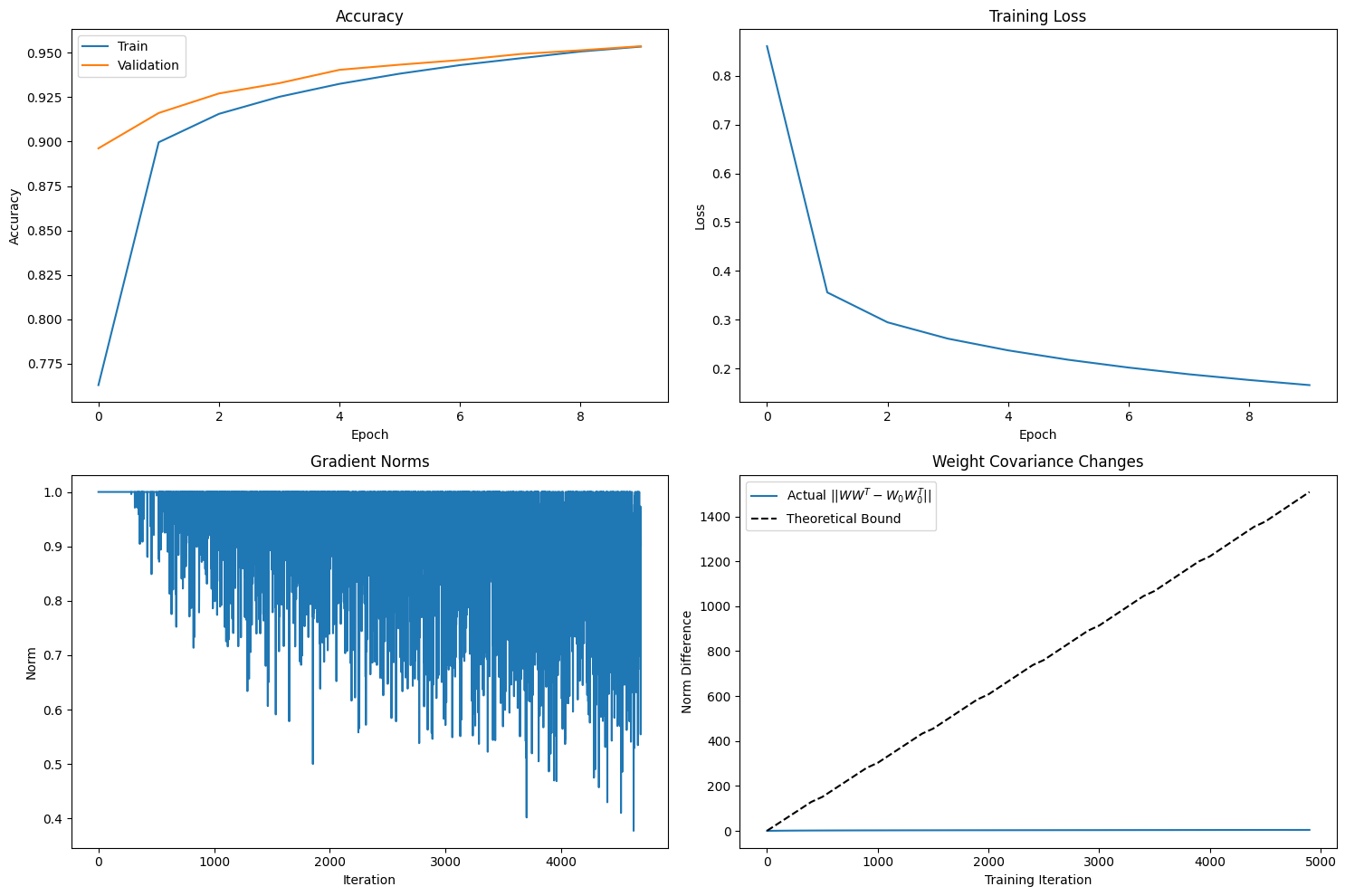
### What does this mean?
- -The bound holds: the actual deviation ($4.12$) is indeed less than the calculated upper bound ($1508.95$).
- -The bound is conservative: as is common, it's a worst-case scenario assuming all gradient updates conspire in the most destructive direction. In practice updates are noisy and cancel out, so the real change is much smaller.
- -The real story is the trend: linear growth with $t$ and dependence on $\max(\|W(t)\|, 1)$ are the key insights — and the actual deviation staying orders of magnitude smaller shows training is a remarkably stable perturbation, not a destructive one.
Hope you got some good insights :) Have a great day!